Nexis+AI
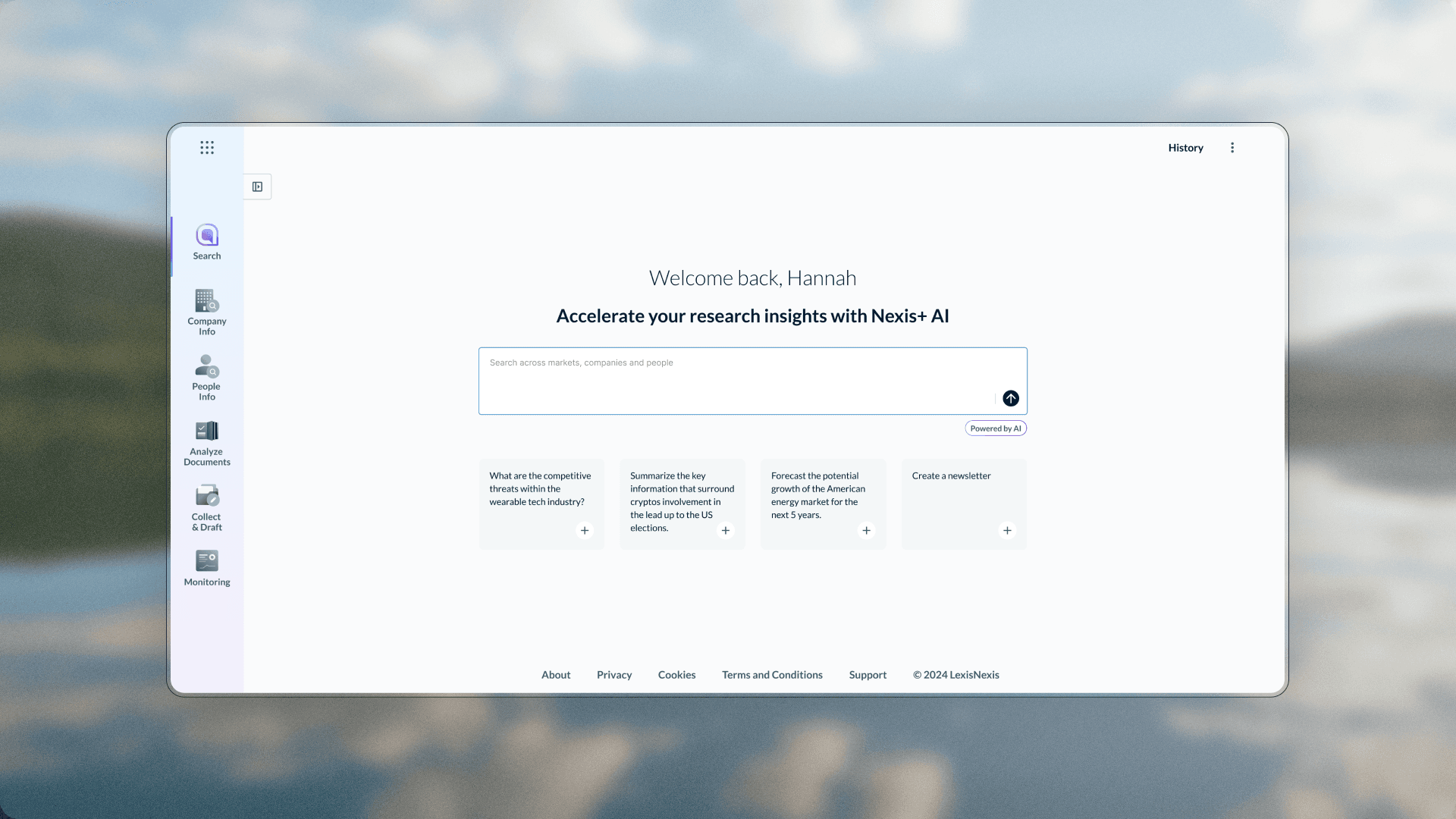
I'm under NDA, for this project so I'm limited to what I can share. If you would like to learn more, please get in touch.
Summary
I spearheaded the design and strategy for an AI search tool, which is the first of their kind for LexisNexis.
Problem
Business consultants waste their time and resources wading through noise, their effectivness in making informed decisions relies heavily on obtaining clear data at speed. That data can be hard to find and is typically never found in one place.
Design solution
AI model that identifies user intent, searches across 12,000 publishers and service's information in a structured format. The tool allows the user to identify the signals meaningful to them and drill down into the data to obtain more vital information.
Worked with:




Disciplines:
Product strategy
Human interface design
Interaction design
Design systems
Research
Art direction
Timeframe:
2023 - Ongoing
Process & Methodology
Take a glimpse into my work, how I've approached problems, collaborated with people and informed my designs.



What did I learn from this
Find shared language to co-create
I spent a lot of time working with data scientists to build AI models. When designing the user intent, we often explored similar experiments and assumptions sometimes without realising it. This is a great example of the importance of understanding the overlapping relationships we have and the ability to boost productivity based on our different perspectives.
Data scientists use technical intuition whereas I study behaviour and systems. We communicate through diagrams of observations, flow charts, outcomes.
For every collaborator, there is a shared language; find it and find a key.
Concise communication
This project caused such excitement that it was closely observed by the leadership team of LexisNexis. I was responsible for owning the quarterly design progress review with the CEO.
Creating that connection with senior leadership, understanding their direction and having the confidence to provide my expert opinion helped boost my confidence. I've had to push my presenting skills to match the business focused approach of leadership. This has given me the insight and ability to articulate the importance of design within the product space.
Most problems are search problems
When we help users get to what they need, it’s through search. Navigating, way-finding, browsing, personalising, recommending are all search problems.
Search doesn’t have to be the action of a human. A truly intelligent experience should search on their behalf, surfacing timely, relevant suggestions that gently guide behaviour in the right direction. It is important to note that search much conform to the users mental model and behaviour.
AI tools have their own pain points
People look at AI being this perfect solution to everything, what I've noticed is the truth is the opposite. While designing the search experience I noticed multiple pitfalls that an unassuming designer would have fallen into. For example, AI summary tools are great for drawing information together, but this causes a new pain point, where did the information come from. When the stakes are as high as they are for a business consultant they have to check every source. So I created a new success metric called "Time to validation". This metric measures the time for the user to identify the source, its reputation and if it meets the users level of usefulness. I designed multiple variations to reduce the time to validation to the point where source checking is no longer a pain point to the user.
Capabilities + Context = Concept
Designers are taught to work with processes like the double diamond, the idea is this will help them to design a more complete and successful product at the end. I'm not here questioning the double diamond but after years of understanding the technology of AI and speaking with some of the leading industry experts like Dan Saffer I've built my own frameworks and processes that are directly for AI concept creation.
AI is not a feature you need to market
The focus should be on the quality of the experience, not the underlying technology. Ultimately, the aim is to deliver the best possible service whether it’s powered by machine learning, natural language processing, or any other technology.

