Contact
Research & Customer Insights
Research & Customer Insights
Design wouldn't mean anything without research and understanding the customer base. That is why my work consists of being a proficient researcher as well as a designer.
01
01
Answer Quality Testing (AQT)
User Behaviour
In conversational AI search, the value lies in the quality of responses, but without a way to measure that quality, improvement becomes guesswork. To address this, I introduced Answer Quality Testing and led the first round of AQT, creating a framework to monitor how well responses met user needs. This gave the team a clear lens on where the model was falling short and where to focus resources. When I later rewrote the underlying prompts, AQT revealed a significant uplift in response quality, proving the approach’s effectiveness and paving the way for ongoing monitoring across the product.
In conversational AI search, the value lies in the quality of responses, but without a way to measure that quality, improvement becomes guesswork. To address this, I introduced Answer Quality Testing and led the first round of AQT, creating a framework to monitor how well responses met user needs. This gave the team a clear lens on where the model was falling short and where to focus resources. When I later rewrote the underlying prompts, AQT revealed a significant uplift in response quality, proving the approach’s effectiveness and paving the way for ongoing monitoring across the product.
In conversational AI search, the value lies in the quality of responses, but without a way to measure that quality, improvement becomes guesswork. To address this, I introduced Answer Quality Testing and led the first round of AQT, creating a framework to monitor how well responses met user needs. This gave the team a clear lens on where the model was falling short and where to focus resources. When I later rewrote the underlying prompts, AQT revealed a significant uplift in response quality, proving the approach’s effectiveness and paving the way for ongoing monitoring across the product.
In conversational AI search, the value lies in the quality of responses, but without a way to measure that quality, improvement becomes guesswork. To address this, I introduced Answer Quality Testing and led the first round of AQT, creating a framework to monitor how well responses met user needs. This gave the team a clear lens on where the model was falling short and where to focus resources. When I later rewrote the underlying prompts, AQT revealed a significant uplift in response quality, proving the approach’s effectiveness and paving the way for ongoing monitoring across the product.
02
02
Co-Designing North Star
Co-Designing North Star
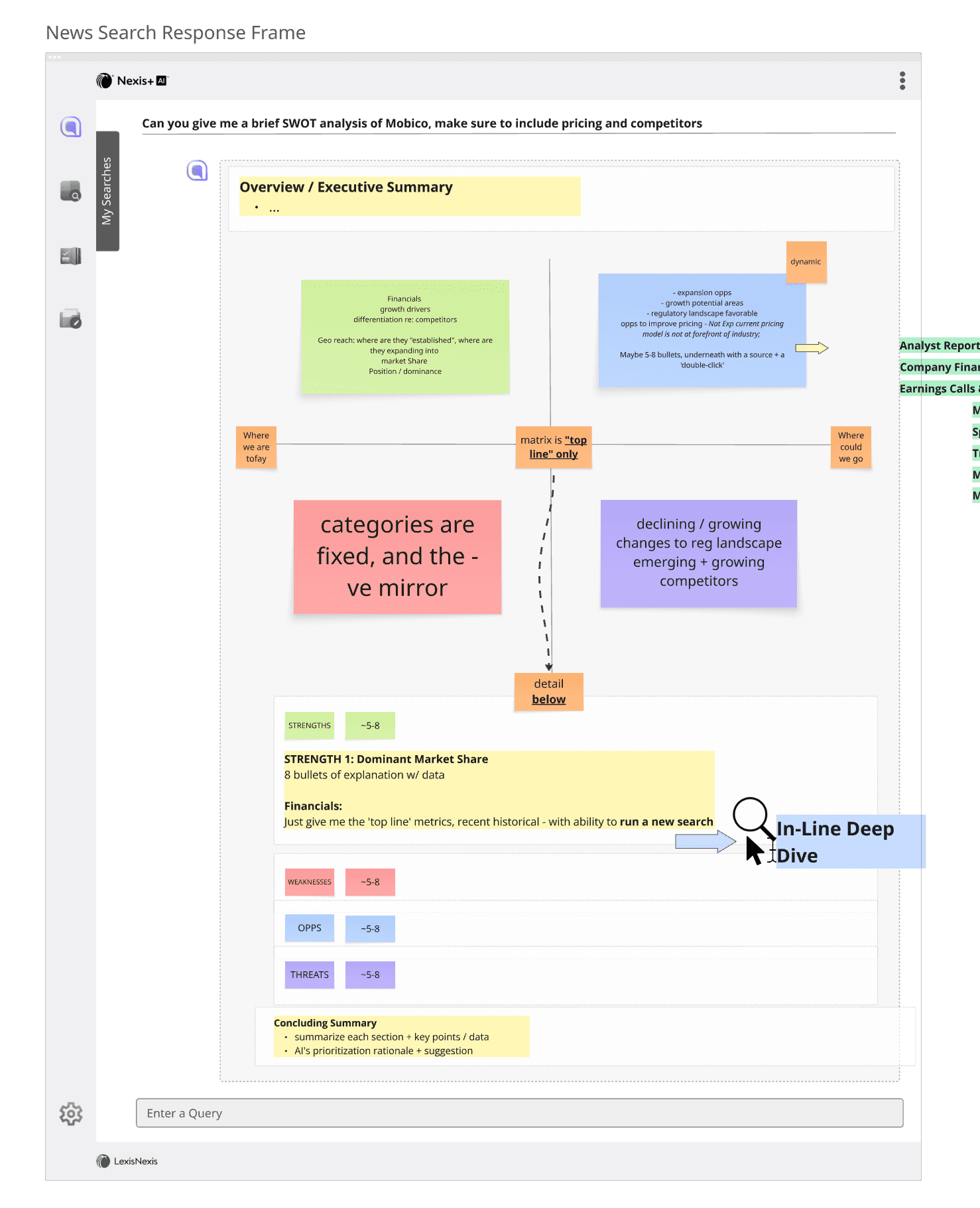
I led the research and design of our flagship investigative initiative, Co-Design, the most pivotal piece of work this year shaping our product vision and AI design strategy. The objective was to uncover how business context, use case scenarios, and user intent inform the definition of an ideal AI response, one that balances UX, key data, sources, functionality, interaction, and user behaviour. To achieve this, in-depth interviews, were conducted, with business consultants, analysing not only what questions they asked but also the business logic and lived context behind those queries.
My approach combined rigorous research with collaborative design:
Reviewing participant ratings and feedback to identify gaps and opportunities.
Mapping roles and responsibilities to better understand how user context shapes intent.
Exploring how participants frame and answer questions in real-world practice.
Co-designing ideal responses with participants, which I visualised in clear, simple forms before applying my own advanced frameworks to refine them.
Closing the loop by returning matured designs to participants for validation, creating an iterative feedback cycle.
This process has been instrumental in defining the product’s vision and design architecture. The results have also been adopted by wider teams, including data science, product, and strategy, strengthening alignment across the business and ensuring consistency from design through implementation.
The work has been recognised internally as a breakthrough in AI-human interaction design, earning high praise from the CEO, who continues to track its progress closely. The resulting designs are not only innovative but also strategic in pushing the boundaries of AI design architecture and functionality, laying the foundation for the next generation of AI-driven experiences.
I led the research and design of our flagship investigative initiative, Co-Design, the most pivotal piece of work this year shaping our product vision and AI design strategy. The objective was to uncover how business context, use case scenarios, and user intent inform the definition of an ideal AI response, one that balances UX, key data, sources, functionality, interaction, and user behaviour. To achieve this, in-depth interviews, were conducted, with business consultants, analysing not only what questions they asked but also the business logic and lived context behind those queries.
My approach combined rigorous research with collaborative design:
Reviewing participant ratings and feedback to identify gaps and opportunities.
Mapping roles and responsibilities to better understand how user context shapes intent.
Exploring how participants frame and answer questions in real-world practice.
Co-designing ideal responses with participants, which I visualised in clear, simple forms before applying my own advanced frameworks to refine them.
Closing the loop by returning matured designs to participants for validation, creating an iterative feedback cycle.
This process has been instrumental in defining the product’s vision and design architecture. The results have also been adopted by wider teams, including data science, product, and strategy, strengthening alignment across the business and ensuring consistency from design through implementation.
The work has been recognised internally as a breakthrough in AI-human interaction design, earning high praise from the CEO, who continues to track its progress closely. The resulting designs are not only innovative but also strategic in pushing the boundaries of AI design architecture and functionality, laying the foundation for the next generation of AI-driven experiences.
I led the research and design of our flagship investigative initiative, Co-Design, the most pivotal piece of work this year shaping our product vision and AI design strategy. The objective was to uncover how business context, use case scenarios, and user intent inform the definition of an ideal AI response, one that balances UX, key data, sources, functionality, interaction, and user behaviour. To achieve this, in-depth interviews, were conducted, with business consultants, analysing not only what questions they asked but also the business logic and lived context behind those queries.
My approach combined rigorous research with collaborative design:
Reviewing participant ratings and feedback to identify gaps and opportunities.
Mapping roles and responsibilities to better understand how user context shapes intent.
Exploring how participants frame and answer questions in real-world practice.
Co-designing ideal responses with participants, which I visualised in clear, simple forms before applying my own advanced frameworks to refine them.
Closing the loop by returning matured designs to participants for validation, creating an iterative feedback cycle.
This process has been instrumental in defining the product’s vision and design architecture. The results have also been adopted by wider teams, including data science, product, and strategy, strengthening alignment across the business and ensuring consistency from design through implementation.
The work has been recognised internally as a breakthrough in AI-human interaction design, earning high praise from the CEO, who continues to track its progress closely. The resulting designs are not only innovative but also strategic in pushing the boundaries of AI design architecture and functionality, laying the foundation for the next generation of AI-driven experiences.
I led the research and design of our flagship investigative initiative, Co-Design, the most pivotal piece of work this year shaping our product vision and AI design strategy. The objective was to uncover how business context, use case scenarios, and user intent inform the definition of an ideal AI response, one that balances UX, key data, sources, functionality, interaction, and user behaviour. To achieve this, in-depth interviews, were conducted, with business consultants, analysing not only what questions they asked but also the business logic and lived context behind those queries.
My approach combined rigorous research with collaborative design:
Reviewing participant ratings and feedback to identify gaps and opportunities.
Mapping roles and responsibilities to better understand how user context shapes intent.
Exploring how participants frame and answer questions in real-world practice.
Co-designing ideal responses with participants, which I visualised in clear, simple forms before applying my own advanced frameworks to refine them.
Closing the loop by returning matured designs to participants for validation, creating an iterative feedback cycle.
This process has been instrumental in defining the product’s vision and design architecture. The results have also been adopted by wider teams, including data science, product, and strategy, strengthening alignment across the business and ensuring consistency from design through implementation.
The work has been recognised internally as a breakthrough in AI-human interaction design, earning high praise from the CEO, who continues to track its progress closely. The resulting designs are not only innovative but also strategic in pushing the boundaries of AI design architecture and functionality, laying the foundation for the next generation of AI-driven experiences.
03
03
Evidence Based Design
Evidence Based Design
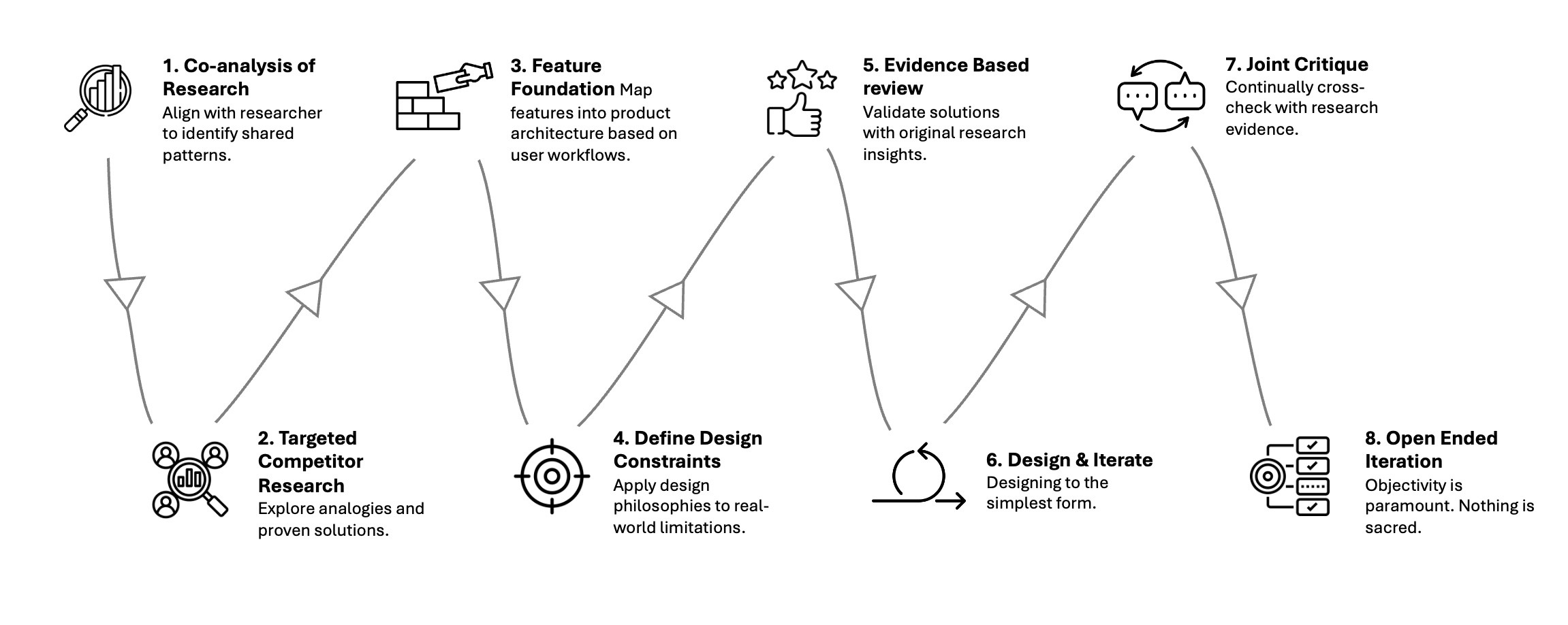
Great design isn’t built on assumptions, it’s grounded in evidence. I created an iterative research process that ensures every creative decision connects back to real user needs, business context, and system constraints. This approach is problem-first, not feature-first, drawing inspiration from solutions to similar challenges both near and far. Every design choice can be traced back to data, and critique sessions with researchers. The result is design that is not only creative, but also defensible, scalable, and aligned with real-world impact.
Great design isn’t built on assumptions, it’s grounded in evidence. I created an iterative research process that ensures every creative decision connects back to real user needs, business context, and system constraints. This approach is problem-first, not feature-first, drawing inspiration from solutions to similar challenges both near and far. Every design choice can be traced back to data, and critique sessions with researchers. The result is design that is not only creative, but also defensible, scalable, and aligned with real-world impact.
Great design isn’t built on assumptions, it’s grounded in evidence. I created an iterative research process that ensures every creative decision connects back to real user needs, business context, and system constraints. This approach is problem-first, not feature-first, drawing inspiration from solutions to similar challenges both near and far. Every design choice can be traced back to data, and critique sessions with researchers. The result is design that is not only creative, but also defensible, scalable, and aligned with real-world impact.
Great design isn’t built on assumptions, it’s grounded in evidence. I created an iterative research process that ensures every creative decision connects back to real user needs, business context, and system constraints. This approach is problem-first, not feature-first, drawing inspiration from solutions to similar challenges both near and far. Every design choice can be traced back to data, and critique sessions with researchers. The result is design that is not only creative, but also defensible, scalable, and aligned with real-world impact.
04
04
Use Cases
Use Cases
Too often, companies start with a tool in mind, like “We need AI for sales outreach”, only to discover later that the real bottleneck lies elsewhere, such as disorganised data or inconsistent processes. Until the use case is fully understood, choosing software is premature. Sometimes the right solution isn’t the one first imagined, but the one that best addresses the underlying problem.
Business consultants have such broad and complex use cases that it is challenging to design for them. One must breakdown their profiles into granular cases, identifying the core pain points and behaviours for each and on then can you start to mould a solution. My relationship with the research and strategy teams are integral to building mature use case profiles.
User Behaviour
If you haven't realised by now, my biggest fascination is user behaviour. Designing without a deep understanding user behaviour traits and risks, leads to inevitably creating design that feel disconnected from real needs. Without this focus, products often surface pain points: confusing navigation, broken expectations, and unnecessary friction that erodes trust. By getting into the mindset of the target audience, knowing their expectations better than they can articulate themselves, I’m able to design end-to-end experiences that anticipate their actions and remove friction. This alignment ensures that every step of the product feels natural, purposeful, and built around how users truly work.
If you haven't realised by now, my biggest fascination is user behaviour. Designing without a deep understanding user behaviour traits and risks, leads to inevitably creating design that feel disconnected from real needs. Without this focus, products often surface pain points: confusing navigation, broken expectations, and unnecessary friction that erodes trust. By getting into the mindset of the target audience, knowing their expectations better than they can articulate themselves, I’m able to design end-to-end experiences that anticipate their actions and remove friction. This alignment ensures that every step of the product feels natural, purposeful, and built around how users truly work.
If you haven't realised by now, my biggest fascination is user behaviour. Designing without a deep understanding user behaviour traits and risks, leads to inevitably creating design that feel disconnected from real needs. Without this focus, products often surface pain points: confusing navigation, broken expectations, and unnecessary friction that erodes trust. By getting into the mindset of the target audience, knowing their expectations better than they can articulate themselves, I’m able to design end-to-end experiences that anticipate their actions and remove friction. This alignment ensures that every step of the product feels natural, purposeful, and built around how users truly work.
If you haven't realised by now, my biggest fascination is user behaviour. Designing without a deep understanding user behaviour traits and risks, leads to inevitably creating design that feel disconnected from real needs. Without this focus, products often surface pain points: confusing navigation, broken expectations, and unnecessary friction that erodes trust. By getting into the mindset of the target audience, knowing their expectations better than they can articulate themselves, I’m able to design end-to-end experiences that anticipate their actions and remove friction. This alignment ensures that every step of the product feels natural, purposeful, and built around how users truly work.
Check out my other notes
HS
HS
HS
HS